Caro-Kann Defense: Complete Guide to Mastering This Solid Chess Opening



Albin Counter Gambit: Sharp Chess Opening Guide
Explore the Albin Counter Gambit in depth with opening theory, positional ideas, critical variations, and practical advice for both White and Black. Learn the plans today.

Dutch Defense: Aggressive Ideas and Winning Plans
Master the Dutch Defense chess opening and learn how to win with 1…f5. Explore attacking plans, structures, and practical strategies now.

Queen’s Indian Defense: Theory, Ideas & Main Lines
Queen’s Indian Defense explained with simple ideas, common variations, and practical tips. Discover how to play this powerful chess opening for Black.

Baltic Defense: Aggressive Chess Opening Explained
Discover the Baltic Defense in chess with clear explanations, key plans, and tactical traps. Improve your opening play and surprise rivals today.

Chigorin Defense: Key Ideas, Theory & Traps
Learn the Chigorin Defense with key ideas, main lines, traps, and strategy tips. Discover how Black creates active play against 1.d4.

The Caro-Kann Defense is one of the most reliable and time-tested defenses against 1.e4. It is famous, with its rock-solid pawn formation and a deep strategic base that provides Black with a safe but flexible position.
The Caro-Kann opening has been employed by the majority of the elite players, including Karpov and Carlsen, to neutralize aggressive players and move towards winning endgames, but you need to keep practicing by playing chess.
Unlike easy chess openings for beginners that rely on quick tactics like the 5 move checkmate or fool's mate, the Caro-Kann focuses on long-term positional understanding, making it ideal for players who prefer stability over chaos.
Table of contents
What Is the Caro-Kann Defense?
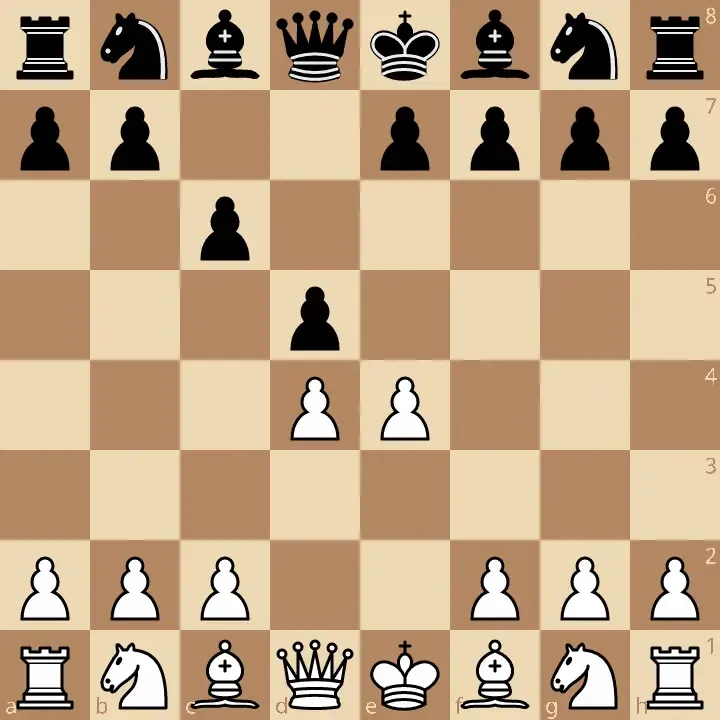
The Caro-Kann Defense (also written as Caro-Kann Defense, Caro-Kann Defence, or Caro-Kann Defense) is a classic response to 1.e4.
It begins with the moves: 1.e4 c6 2.d4 d5
In this case, Black instantly counters the centre without losing a good pawn formation. The c6 pawn also facilitates the push of a d5 in the center, as compared to the French Defense, where the bishop of Black is blocked.
This move order defines the Caro Kahn opening, emphasizing balance, control, and long-term safety rather than short-term traps like the 2 move checkmate or 4 move checkmate.
Why Play the Caro-Kann Defense?
Many beginners ask how to get better at chess, and there are several ways to be better, but learning chess opening defense, like the Caro-Kann, can really help you get better.
Strengths of the Caro-Kann
- Very solid pawn formation: This formation by Black limits the vulnerability, particularly in light squares.
- Ideal in the mind of strategic players: This system is a favorite among tactical players who are fond of counterstriking instead of being the aggressor.
- Tested at all ranks: From the mere club amateur to the Grandmaster, the chess Caro-Kann is a weapon well tested.
Weaknesses of Caro-Kann
- Minor positions of passivity: White tends to obtain more space in the initial stages of the game.
- Needs to understand well the structures of the pawns: memorizing is not going to help.
- There is a need to be accurate in transitioning to the middlegame: Misplaced bishops or slow development can provide White with an advantage.
Main Caro-Kann Defense Variations
The Caro-Kann variations characterize the way both parties play the game. We shall discuss the most popular systems.
Classical Variation (3.Nc3 or 3.Nd2 dxe4 4.Nxe4 Bf5)

Such is the conventional type of the Caro-Kann opening, the Black alternating in the centre and working up the bishop.
Central move: Black is seeking to evolve without any issues with...e6,...Nd7, and...Ngf6.
Plan of White: Develop the pressure at the kingside and create space through such moves as Nf3 and Ne5.
The Classical system provides both parties with a level game of positional tension.
Advance Variation (1.e4 c6 2.d4 d5 3.e5)

This variation of Caro-Kann is one of the most popular, and it locks the center at the beginning.
The arrangement of Black: ...Bf5, ...e6, ...Nd7, ...c5 — It was a counterattack formation.
The strategy White intends to employ: Space with f4 and Be3.
This variation has been applied in the best games played by Magnus Carlsen and Anatoly Karpov. It's strategic and deep, demanding patience instead of chasing the fastest checkmate ideas.
Exchange Variation (1.e4 c6 2.d4 d5 3.exd5)

Symmetrical structures are brought about by the Exchange Variation.
White: White to apply premature pressure by means of open lines.
The strategy of Black: Build speedily and be active on the queenside.
It is a naked battle of position, and both players put themselves to the test as to their end-game skills, so as to provide good practice in terms of bishop knight patterns of checkmate.
Panov-Botvinnik Attack (1.e4 c6 2.d4 d5 3.exd5 cxd5 4.c4)

Such an aggressive arrangement presents the isolated pawn positions (IQP).
White wants to use the isolated pawn to dominate the center and attack.
Black's counterplay: Targeting the weak pawn and exchanging into favorable endgames.
The Caro-Kann defense in chess usually passes on to intricate middlegames where each of the parties can win.
Other Notable Lines
- Fantasy Variation (1.e4 c6 2.d4 d5 3.f3): Aggressive and quite dangerous; pushing pawns in the early stages may cause the weakening of the White king.
- Two Knights Variation (1.e4 c6 2.Nc3 d5 3.Nf3): Development and mobility of pieces are given priority.
These systems are not widespread, but they are still worth trying in case you want to surprise your opponent.
How to Play the Caro-Kann Defense (Step-by-Step)
Mastering the Caro-Kann defense involves understanding key principles rather than memorizing moves.
- Dominate the center, 1...c6, 2...d5.
- Answer in accordance with the variation of White (Advance, Classical, Exchange).
- Build the light-squared bishop and lock up with...e6.
- Castle kingside with safety and without risk, and prepare central counterplay.
- Enter into endgames with a solid pawn structure.
Remember, while tactics like 5 move checkmate win instantly, strategic systems like the Caro-Kann win through precision and structure.
And if you're ever wondering, can a king check a king? The answer is no, the Caro-Kann will teach you why by emphasizing positional awareness and control.
Caro-Kann Defense in Modern Chess
The Caro-Kann Defense has never gone out of style. It remains one of the most reliable defensive choices in FIDE-rated classical and rapid tournaments, maintaining close to a 50% score for Black against 1.e4 across multiple formats.
It is also gaining popularity in blitz games and rapid games due to the low-risk factor and the ability to have a strategic plan, which allows players to gain skills in playing chess after a certain duration.
Conclusion
The Caro-Kann Defense is a cornerstone of solid chess strategy. It is not flaunting like traps or short mates, but its long-lasting power is in its design, logic, and trustworthiness.
Being a beginner who can find easy chess openings as a beginner or an experienced player who wants to improve on positional play, the Caro-Kann is an investment worth a lifetime.
FAQs
- Yes, it is a good game to start with, and avoid initial mistakes and develop a solid base in the positional game.
- Classical and Advanced both are strong and versatile toward improvement in the long term.
- In the French Defense, the bishop on c8 frequently becomes trapped, and in the Caro-Kann, it freely develops to f5 then to e6.
- Not without going out there, but White can learn initially to figure out how to overcome solid defensive formations.
- It is the only time control that has safety and strategy depth, and hence suits both classical and modern gameplay.
Albin Counter Gambit: Sharp Chess Opening Guide
Explore the Albin Counter Gambit in depth with opening theory, positional ideas, critical variations, and practical advice for both White and Black. Learn the plans today.
Dutch Defense: Aggressive Ideas and Winning Plans
Master the Dutch Defense chess opening and learn how to win with 1…f5. Explore attacking plans, structures, and practical strategies now.
Queen’s Indian Defense: Theory, Ideas & Main Lines
Queen’s Indian Defense explained with simple ideas, common variations, and practical tips. Discover how to play this powerful chess opening for Black.
Baltic Defense: Aggressive Chess Opening Explained
Discover the Baltic Defense in chess with clear explanations, key plans, and tactical traps. Improve your opening play and surprise rivals today.
Chigorin Defense: Key Ideas, Theory & Traps
Learn the Chigorin Defense with key ideas, main lines, traps, and strategy tips. Discover how Black creates active play against 1.d4.