Chess Notation Explained: A Complete Guide to Reading and Writing Algebraic Notation



Types of Chess: Explore All Variants and How They're Played
Discover the different types of chess, including classical, rapid, blitz, and modern variants. Learn the rules, differences, and pick the best one to play today.

Castling in Chess: Rules, Long Castling & How to Castle
Castling in chess is a special move that allows the king and rook to move at the same time, helping protect the king and activate the rook for better board control.
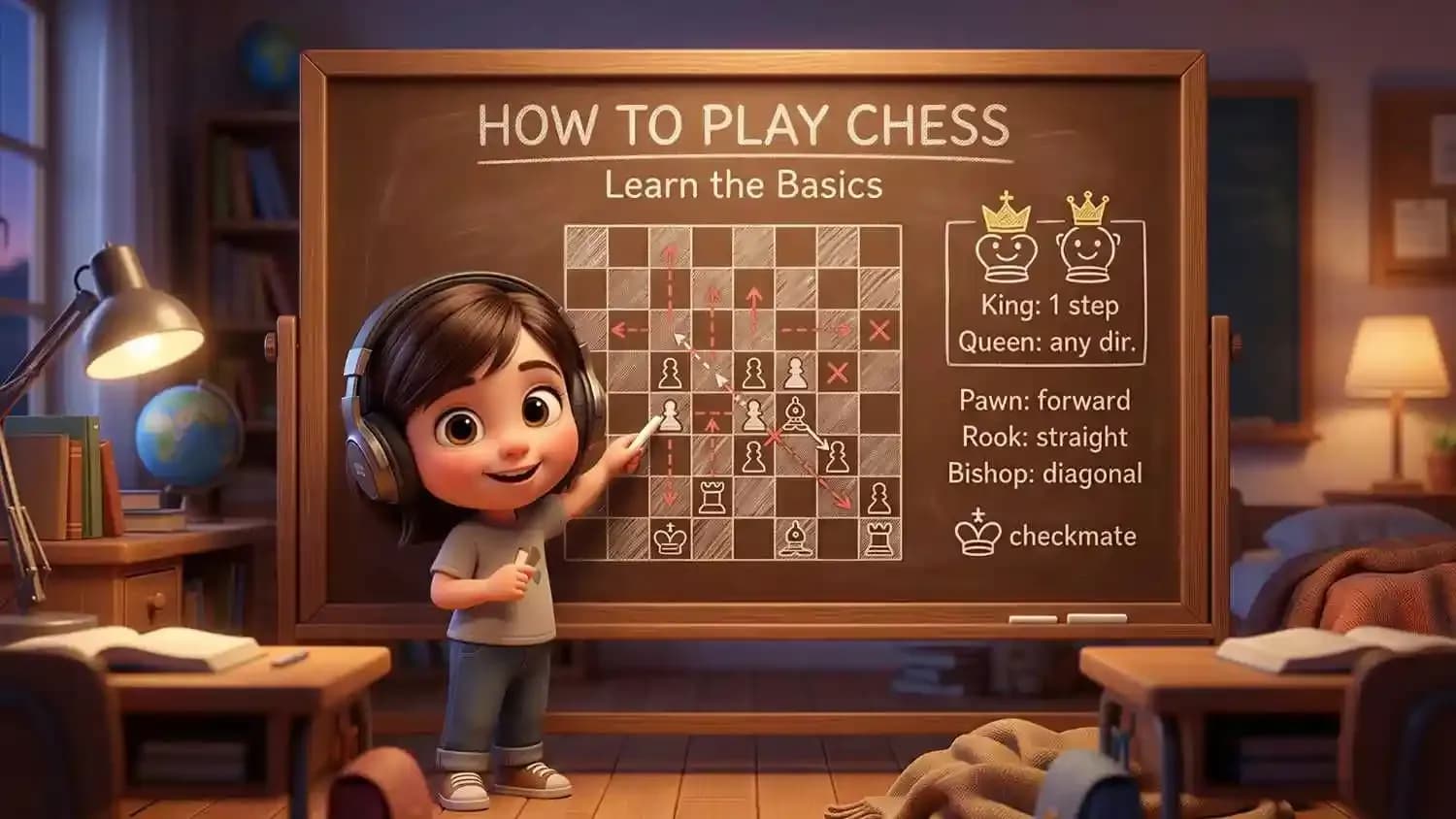
How to Play Chess: Easy Rules & Beginner Tips
How to play chess explained simply with board setup, piece rules, checkmate basics, and beginner strategies. Follow this guide and start playing today.

Youngest Chess World Champion: Top 10 Youngest Champions in History
Only a handful of players have ever claimed the title of youngest chess world champion, and the record keeps getting shattered. From Gukesh Dommaraju's historic 2024 win at just 18 to Kasparov's 40-year reign atop the record books, here's the full ranked list, timeline, and the rising prodigies who could break it next.

Chess Notation Explained: A Complete Guide to Reading and Writing Algebraic Notation
Master chess notation with our complete guide covering algebraic symbols, board coordinates, special moves and annotations. Start reading games today!

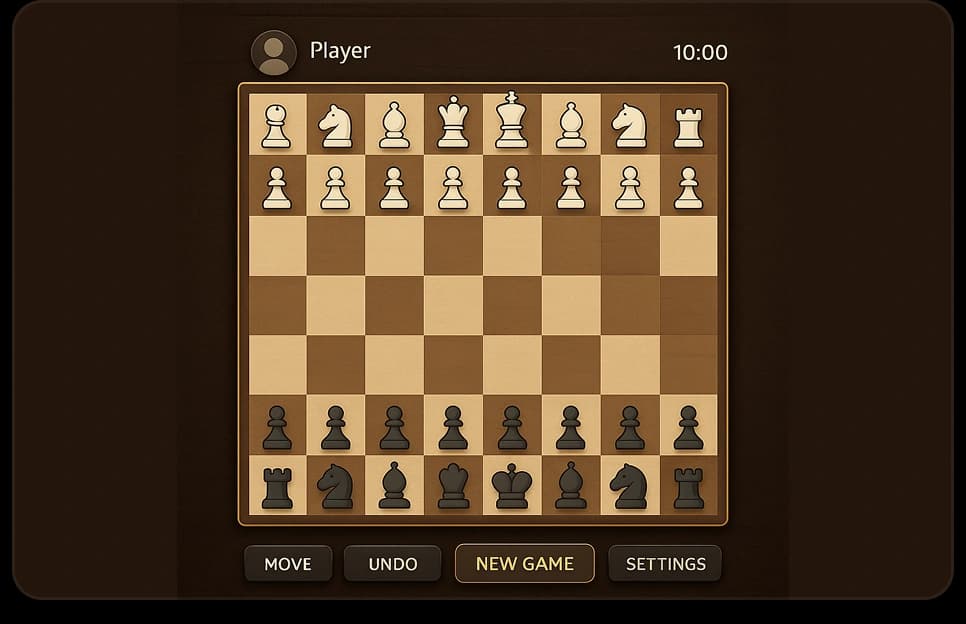
Playing chess using the notations is the quickest method for learning how to improve your game of chess because the notation enables you to access many grandmaster games, lessons on tactics, and even find out if there is anything wrong with your game. Anyone who has read any books about chess or any online chess board has seen things like 1.e4 e5 2.Nf3.
The language is called algebraic chess notation, and it is an internationally recognized format for reporting all moves on the board. Mastering the art of reading chess notation is one of the most important things that you could learn if you wish to find out how to improve your chess playing skills, especially when you play chess online to study your matches and track your strategic growth.
Table of contents
- What Is Chess Notation?
- How the Chess Board Is Labeled (Chess Board Notation)
- Piece Abbreviations in Algebraic Chess Notation
- How to Write a Chess Move: Step by Step
- Special Moves in Chess Notation
- Best Move in Algebraic Chess Notation: Annotation Symbols
- Types of Chess Notation
- Chess Notation Examples: Reading a Full Opening
What Is Chess Notation?
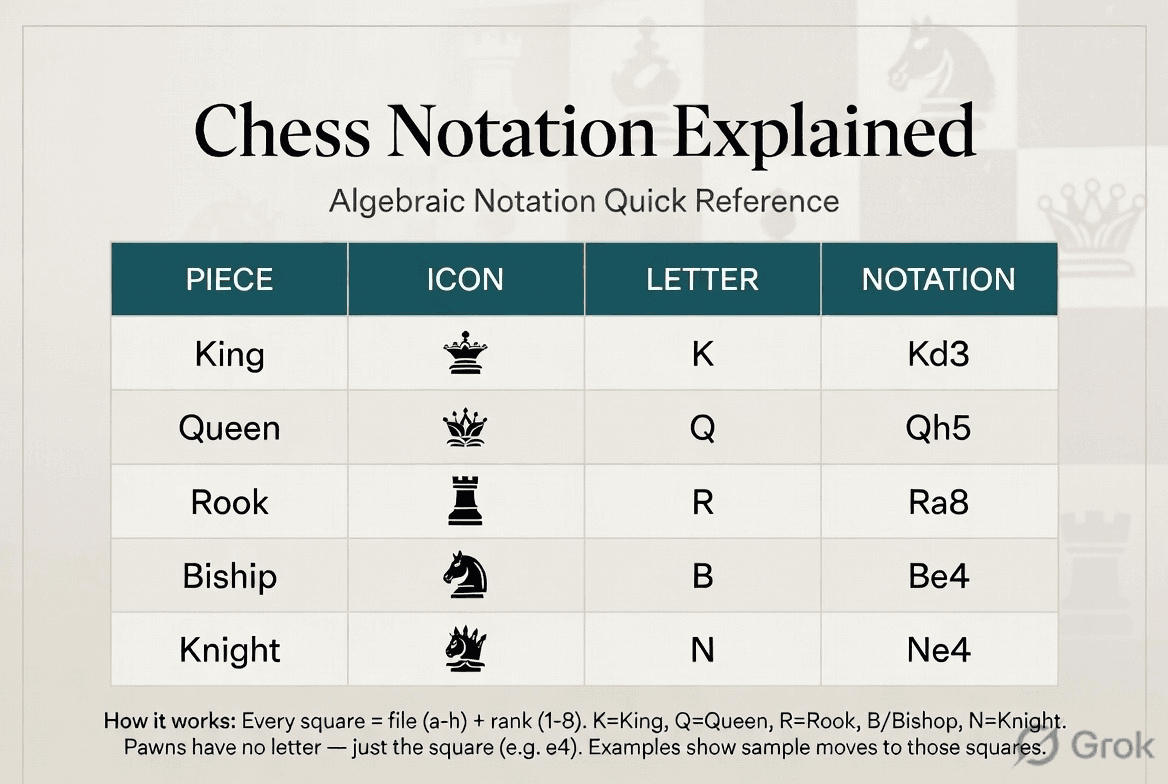
Chess notation is a system employed to document the progress of a chess game. It may be seen as the script of a drama or the notation of music. Through its use, a total game of up to 80 moves can be recorded on one page of paper.
Historically, players used various messy and confusing chess notations, but the global community has unified around a single version: Algebraic Notation Chess. This system uses a clean grid coordinate layout to pinpoint exactly which piece moves, where it lands, and how a favorite chess opening unfolds on the board.
Whether you are dealing with historical games, solving puzzles, or analyzing your own games on a computer chess analysis board, it will be algebraic notation that will help you out.
How the Chess Board Is Labeled (Chess Board Notation)

Before you can write down a move, you must understand how the battlefield is mapped. The foundation of all modern notation relies on a chess board with notation coordinates built right into the margins.
A chess board consists of 64 squares arranged in an 8×8 grid. In order to identify each square uniquely, there is a system of numbering the columns and rows of the chessboard:
- Files: These are the columns running vertically up and down the board. They are labeled with lowercase letters a through h, moving from left to right from White's perspective.
- Ranks: Ranks are rows on the chessboard. They are numbered from 1 to 8, starting from the row closest to the White side of the board.
By combining the file letter and the rank number, every single square gets a two-character name. The letter always comes first. For example, the intersection of the e-file and the 4th rank creates the famous central square e4. Once you map this coordinate grid, you can combine these square locations with standard chess piece names to accurately record every action in your game.
To see this grid in action, review this clear chess board notation reference table mapping out the critical zones of the board:
| Corner / Area | Square Name | Location & Tactical Meaning |
|---|---|---|
| White's bottom-left | a1 | White's queenside rook starting square |
| White's bottom-right | h1 | White's kingside rook starting square |
| Center of the board | d4, d5, e4, e5 | The four central squares crucial for early control |
| Black's bottom-left | a8 | Black's queenside rook starting square |
| Black's bottom-right | h8 | Black's kingside rook starting square |
Critical Rule to Remember: Square coordinates are always written from White's perspective. Rank 1 is always White's home row, and rank 8 is always Black's home row, regardless of whose turn it is or which side of the physical board you are sitting on.
Piece Abbreviations in Algebraic Chess Notation
Now that you have learned the names of the squares, you need to learn how to identify the pieces moving on these squares. When learning the foundational chess rules, you learn that each piece type has its own character. In notation, they each get a single capital letter.
The abbreviations are incredibly easy to memorize, with one very important exception:
| Piece | Abbreviation | Important Tactical Note |
|---|---|---|
| King | K | Must be capitalized; absolute priority piece |
| Queen | Q | The most powerful piece on the board |
| Rook | R | Moves in straight lines along files and ranks |
| Bishop | B | Moves strictly along open diagonals |
| Knight | N | NOT "K" — The letter K is strictly reserved for the King |
| Pawn | (none) | Pawn moves are written without any piece letter at all |
Since the pawns are the infantry in chess, they are always considered as the standard. If the move in the notation does not begin with an uppercase letter, you can tell straight away that it’s a pawn move.
For example, if the notation shows e4, then it shows that the pawn moved to the square e4. However, if the knight moves to that square, the notation will be Ne4. Understanding this baseline is crucial right from the initial chess board set-up, ensuring you track your opening infantry advancements flawlessly.
How to Write a Chess Move: Step by Step
Writing a basic chess move follows a strict, predictable recipe. You simply combine the piece's uppercase letter with the destination square's lowercase coordinate. Also, when you play chess with computer on many websites, you can indicate the moves you used.
Step 1: Write a Basic Move
- For Pieces: Write the piece's uppercase letter, then its destination square. If a knight in chess hops over to the f3 square, you write Nf3. If a bishop slides down to c4, you write Bc4.
- For Pawns: Omit the piece letter entirely and just write the destination square. If a pawn advances to e4, you write e4.
Step 2: Record Both Players' Moves

A full round of chess includes a move by White and a reply by Black. When recording a full game, White's move always comes first on the line, followed immediately by Black's move. They are prefixed by the move number and a single period:
1.e4 e5
This means White moved a pawn to e4, and Black responded by moving a pawn to e5.
If you are reading an instructional article or book and the author wants to show only Black's move in the middle of a commentary sentence, they will use three dots after the move number to indicate White's move has already happened. For example, writing 1...e5 shows Black's opening reply in isolation. Understanding these formatting rules is highly useful if you want to study classic games or learn how to play chess like an expert.
Here is a short, complete chess notation example showing the opening moves of a standard game:
- e4 e5
- Nf3 Nc6
- Bc4 Nf6
Step 3: Resolving Ambiguity (Disambiguation)
Every so often, a situation arises where two identical pieces can move to the exact same destination square. For example, you might have two rooks that both have an open path to the c1 square. If you simply write Rc1, someone reading the game sheet later won't know which rook actually moved.
To fix this, you add a little bit of extra information right after the piece letter to specify where the moving piece came from:
- Add the starting file: If the two rooks are on different columns, add the starting file letter. Rac1 means the rook sitting on the a-file moved to c1.
- Add the starting rank: If the two rooks are on the exact same column but different horizontal rows, add the starting rank number. R1c5 means the rook sitting on rank 1 moved up to c5.
Learning how to navigate these ambiguities is highly useful when studying complex tactical puzzles or reviewing your own games on a digital Chess Analysis Board to ensure your saved records are entirely error-free.
Special Moves in Chess Notation
Chess has several unique tactical actions like captures, promotions, and castling. To keep the game sheet clean, these symbols help players quickly log actions during formal play or when analyzing a tricky chess blunder to see exactly where a game turned around.
| Move Type | Symbol | Example | Meaning and Context |
|---|---|---|---|
| Capture | x | Bxc6 | A bishop captures an enemy piece sitting on the c6 square. |
| Check | + | Bxc6+ | The move places the opponent's king under immediate direct attack. |
| Checkmate | # | Qxf8# | A definitive queen move that delivers an unstoppable checkmate in chess. |
| Kingside Castle | O-O | O-O | The king moves two squares toward the closer kingside rook. |
| Queenside Castle | O-O-O | O-O-O | The king moves two squares toward the further queenside rook. |
| En Passant | e.p. | exd6 e.p. | A pawn captures an enemy pawn sideways using the special en passant rule. |
| Pawn Promotion | = | d8=Q | A pawn reaches the furthest rank and transforms into a brand new queen. |
| Draw Offered | (=) | (=) | A player writes this next to their move to log an official offer of a tie. |
To make sure these are perfectly clear, let's break them down slightly further:
- For a pawn capture, you write the starting file of the pawn, an x, and the destination square, such as exd5.
- When a pawn reaches the opposite end of the board, you immediately place an equals sign after the square, followed by the capital letter of the piece you chose to promote it to.
- The castling symbols use capital letters O (not zeros) to visually represent the distance the rook travels during the maneuver.
Best Move in Algebraic Chess Notation: Annotation Symbols

Whenever grandmasters, trainers, or even computer engines analyze a finished game, they put certain specific punctuation symbols at the very end of each move. These symbols are called annotation symbols , and they assist in making an instant evaluation of the strategic value of that particular move.
The most famous and highly sought-after rating is the best move in algebraic chess notation, which is designated by two exclamation points (!!).
| Symbol | Evaluation Name | Strategic Meaning |
|---|---|---|
| !! | Brilliant Move / Best Move | An exceptional, game-changing move—often an unexpected sacrifice. |
| ! | Good Move | A highly accurate, strong, or well-calculated decision. |
| !? | Interesting Move | A creative, sharp, or risky move that deserves deeper analysis. |
| ?! | Dubious Move | A questionable, sub-optimal choice that might give away an edge. |
| ? | Mistake | A poor move that directly gives the opponent a clear advantage. |
| ?? | Blunder | A severe tactical error that loses major material or ruins the game. |
Seeing a !! An icon on a screen or page means something spectacular just occurred on the board. It represents a deeply calculated tactical sequence that completely alters the evaluation of the position. These symbols are always placed at the very end of the move text, even after any check signs.
Here is a short analytical snippet illustrating how these look on a review sheet:
- 18.Nxf7!! — White unleashes a brilliant knight sacrifice, finding the absolute best move.
- 18...Kxf7?? — Black accepts the piece, committing a game-losing blunder.
- 19.Qxh5+ — White follows up with an accurate, powerful check.
Studying where these annotations appear in your own games is the best way to uncover some critical beginner chess mistake that you should avoid while building lasting structural skills.
Types of Chess Notation
Even though algebraic notation reigns supreme in the chess universe, there may be instances when you encounter some other notation systems in library books and databases.
| Notation Type | How It Works | Real-World Example | Is It Used Today? |
|---|---|---|---|
| Algebraic (SAN) | Piece letter + destination square | Nf3, e4, Bxc6+ | Yes. The absolute universal standard. |
| Long Algebraic | Starting square + destination square | e2e4, g1f3, c4xc6 | Yes. Used behind the scenes by computers. |
| Coordinate | Starting square connected to destination | e2-e4, g1-f3 | Rarely. Used occasionally in beginner apps. |
| Descriptive | Name files by the piece on rank 1 | P-K4, N-KB3 | No. Obsolete since the 1980s. |
| Figurine | Replaces capital letters with symbol icons | ♘f3, ♙e4 | Yes. Common in international print books. |
In case you find yourself looking through an older chess book published before 1980, chances are high that the notation you come across will be Descriptive (P-K4, for example). This should not confuse you since algebraic notation is much more straightforward and quicker to record.
Chess Notation Examples: Reading a Full Opening
Let's put your new decoding skills to the test. Below are chess notation examples mapping out the first five moves of a highly popular opening strategy called the Italian Game.
Example 1: The Italian Main Line

- e4 e5
- Nf3 Nc6
- Bc4 Bc5
- O-O Nf6
- d3 d6
In the event that you were to verbally narrate this classic Italian game opening to a friend, you would interpret these codes into these clear movements:
- Move 1: White moves a pawn to e4; Black responds by moving a pawn to e5.
- Move 2: White develops a knight to f3; Black develops a knight to c6.
- Move 3: White brings a bishop out to c4; Black matches it by bringing a bishop to c5.
- Move 4: White performs a quick kingside castle; Black develops a second knight to f6.
- Move 5: White advances a central pawn to d3; Black advances a matching pawn to d6.
Example 2: Tactical Chaos (Captures and Checks)

Let's look at what happens immediately following that opening if the players get aggressive:
6. Bxf7+ Kxf7
7. Ng5+
Reading this continuation aloud is just as simple: White's bishop captures an enemy piece on the f7 square and puts the opponent's king in check (+). Black's king is forced to capture the attacking white bishop back on f7 (Kxf7). White then brings his knight out to g5, checking again (+).
A few minutes of practice on a daily basis will enable you to recreate all these positions within your mind without having a physical chessboard.
Now that you have learned how to write and read algebraic notation, a completely new scope of improvement is available to you. You can comfortably delve into advanced books about opening chess moves for beginners or document your own chess playing experience, dive deep into chess tactics for beginners, or start documenting your own competitive journey.
FAQs
- Chess notation is a shorthand system used to write down the moves of a chess game. It provides a permanent, step-by-step written archive of a match so players can replay, analyze, and verify the game afterward.
- You read it by identifying the moving piece's capital letter (omitted for pawns) followed by the coordinate address of its destination square. For example, Nf3 translates directly to "Knight moves to the f3 square."
- The double exclamation mark (!!) signifies a brilliant move. It is an annotation symbol reserved for the single absolute best move in a position, often involving a deep, unexpected tactical sacrifice that wins the game.
- ?? marks a mistake. It denotes a colossal tactical mistake or a move that will cause you to lose material, ruin your winning game, or lead to a quick checkmate.
- The letter K can only be used for the king since it is the most valuable piece on the chessboard. To distinguish the King from the Knight, the latter uses the letter N because of its phonetic resemblance.
- Long algebraic notation lists both the starting square and the ending square of a moving piece (such as e2e4 instead of just e4). While human players rarely write this out by hand, it is highly common in programming databases and computer chess engines.
Types of Chess: Explore All Variants and How They're Played
Discover the different types of chess, including classical, rapid, blitz, and modern variants. Learn the rules, differences, and pick the best one to play today.
Castling in Chess: Rules, Long Castling & How to Castle
Castling in chess is a special move that allows the king and rook to move at the same time, helping protect the king and activate the rook for better board control.
How to Play Chess: Easy Rules & Beginner Tips
How to play chess explained simply with board setup, piece rules, checkmate basics, and beginner strategies. Follow this guide and start playing today.
Youngest Chess World Champion: Top 10 Youngest Champions in History
Only a handful of players have ever claimed the title of youngest chess world champion, and the record keeps getting shattered. From Gukesh Dommaraju's historic 2024 win at just 18 to Kasparov's 40-year reign atop the record books, here's the full ranked list, timeline, and the rising prodigies who could break it next.
Chess Notation Explained: A Complete Guide to Reading and Writing Algebraic Notation
Master chess notation with our complete guide covering algebraic symbols, board coordinates, special moves and annotations. Start reading games today!