


Knight in Chess: Moves, Rules & Knight Movement Guide


A knight in chess is one of the most interesting and powerful pieces that can really punish the opponent easily if you know how to use it well.
The beginner also calls the knight the horse chess piece because of its horse-shaped shape. Although it might not be easy to learn at the beginning of time, it is easy to learn the knight chess movement as soon as one comprehends the pattern.
Table of contents
- What Is a Knight in Chess?
- How Does the Knight Move in Chess?
- How Many Spaces Can a Knight Move?
- Knight Movement Rules in Chess
- Knight Movement Examples (Board Positions)
- Why the Knight Is Called the Horse in Chess
- Knight Value in Chess
- Knight vs Bishop (Quick Comparison)
- Common Beginner Mistakes With Knights
- Famous Knight Tactics in Chess
- Final Thoughts
What Is a Knight in Chess?

The knight is a chess piece shaped like a horse and is unique among the pieces on the board in its movement. While they are confined to moving in straight lines, the knight is able to leap over the pieces in a different L-shape.
This jumping ability makes it a nightmare in crowded games. It is able to skip directly into the situation and place a chess fork, striking two pieces simultaneously, and the opponent is unable to root out the threat. You may refer to it either as a knight or a horse, but its ability to strike in places where you can never get, puts it unanimously on top of surprises.
How Does the Knight Move in Chess?
This unique movement allows the knight to be the only piece capable of jumping over others, a trait that is incredibly useful in a Slav defense chess setup, where the center often becomes crowded. By moving in its signature "L" shape, the knight can navigate tight spaces that leave other pieces stuck.
For example, the knight can move:
- Two squares forward and one square to the left.
- Two squares forward and one square to the right.
- Two sideways squares and one square up.
- Two squares sideways and one square down.
This movement pattern creates an “L” shape on the board. This pattern is critical to learning how to perform the knight chess move, since it cannot move in straight lines, unlike most other chess pieces.
How Many Spaces Can a Knight Move?
One of the questions that is often asked is how many squares the knight is able to move. It is always three squares, but in two different directions: two squares in one direction and one square in another direction.
This creates the classic L-shape. One trick of looking at this is that the knight never lands on a square of the same color. When it begins on a dark square, it will never end on a light one.
The alternating pattern allows for easy pursuit of the piece and quick thinking about your next move in a fast-paced game.
Knight Movement Rules in Chess
Knowledge of the official chess rules of movement of knight chess pieces will aid you in playing the piece in the appropriate way at any particular time.
L-Shaped Movement Rule
- The knight has to be constantly in an L-shape. It cannot move straight like the rooks or diagonally like the bishops.
- This means that any movement should be in the form of two squares in a single direction and a square perpendicular to it.
Knights Can Jump Over Pieces
One of the best qualities of the knight is the ability to leap over another piece. In addition, the knight can leap over pawns and pieces, unlike other pieces, which may be blocked by the pieces.
This, unfortunately, renders the knight extremely useful in the initial stages of the game, when many pieces are available on the board.
Knights Capture the Same Way They Move
Knights attack the pieces of the opponent by moving to a square that is occupied by the opponent. The capturing movement resembles the normal movement in an L-shape.
Due to this regulation, knights can be good in surprise attacks and tactical opportunities.
Knight Movement Examples (Board Positions)
- The movement of a knight is dependent on its placement; in the middle, it has the ability to move along eight squares, whereas on the edge or corner, it has four or two choices.
- In chess, powerful players tend to arrange their knights in a castle formation to protect the king before pushing the pieces to the center.
- The fact that the knights are placed as near to the center as possible means that they have the greatest influence on the board.
Why the Knight Is Called the Horse in Chess
Most novices would question what the horse in chess is. The question is easy to answer: the horse is the knight.
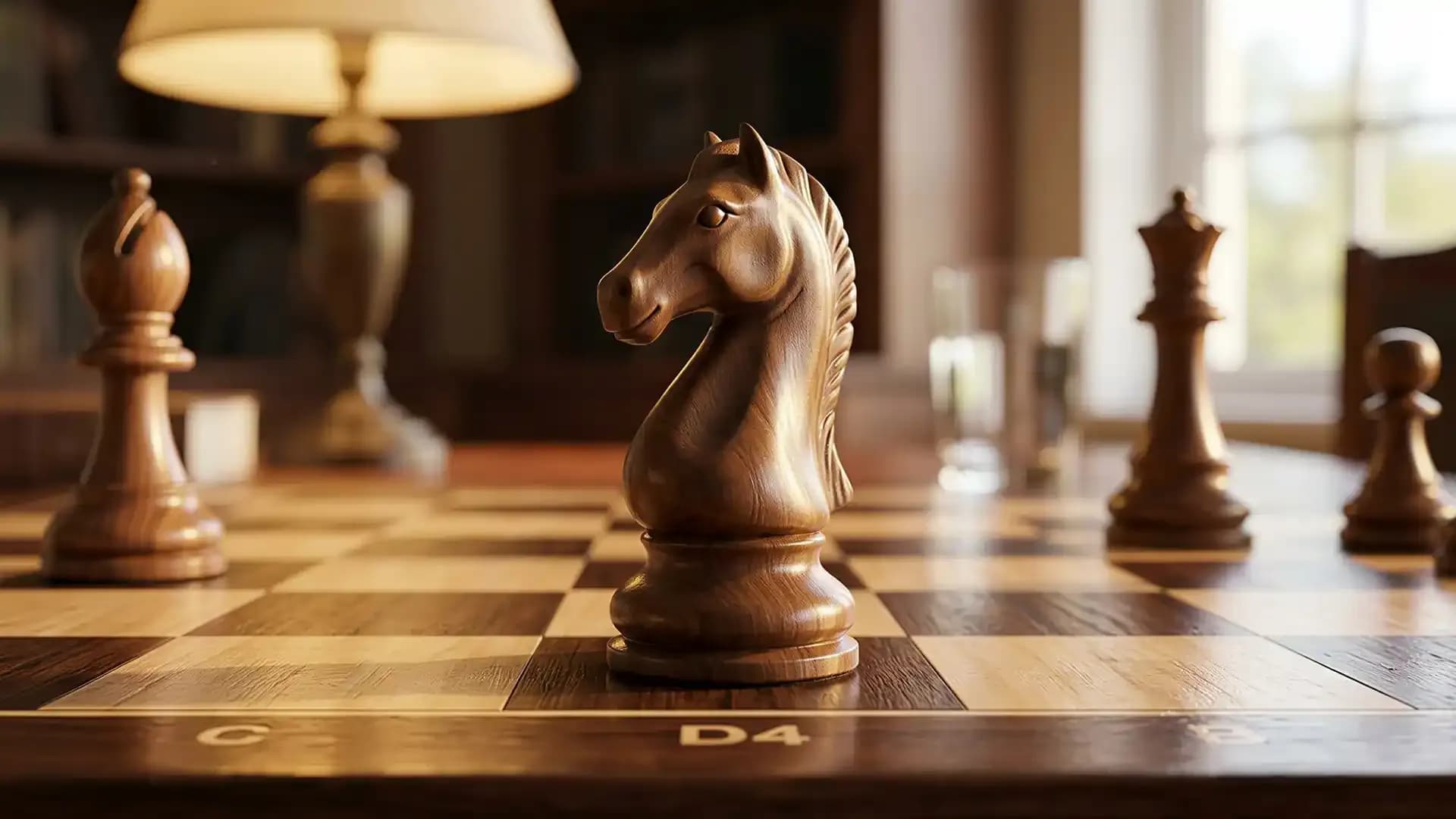
The knight piece is designed to look more like a horse head, which is why players commonly refer to it as a horse chess piece.
The knight is traditionally an image of a mounted soldier in the medieval army. Knights on horseback were quick, unpredictable, and could attack at any angle during medieval warfare.
The knight's movement on the chessboard is a manifestation of this idea. The horse symbol is one of the most familiar chess pieces even nowadays.
Knight Value in Chess
In chess, the pieces are usually assigned a point value to enable the player to have a feel of their relative power.
The knight is normally rated at 3 points, which is also equal to just a bishop. The actual power of a knight is, however, that they can struggle in open positions where long-range pieces take over. These are great chess tips for beginners to keep in mind when deciding which pieces to trade.
Knight Strategy Tips
Learning how to use knights effectively can greatly improve your chess strategy.
Place Knights in the Center
Knights are strongest when placed in the center of the board. From central squares, a knight can attack many different squares and influence a large portion of the board.
Use Knights for Forks
Another famous knight tactic is the knight fork. When the knight attacks two pieces at the same time, then it is said to be a fork, and the opponent must lose some material. Knights particularly enjoy forking kings, queens, and rooks.
Knight vs Bishop (Quick Comparison)
| Feature | Knight | Bishop |
| Movement | L-shape | Diagonal |
| Range | Short | Long |
| Jump ability | Yes | No |
| Best position | Closed games | Open games |
Both pieces are valued at roughly three points, but their strength depends heavily on the type of position on the board.
Common Beginner Mistakes With Knights
Many new players struggle with how chess pieces move and often make similar mistakes, like placing knights on the edge of the board. Beginners also often forget about forks, with the help of which a knight can strike two pieces simultaneously.
Famous Knight Tactics in Chess
Various mighty tactical patterns were popular among knights. One of the most famous is the knight fork move, which eliminates two or more pieces one at a time.
The other is the knight outpost, when a knight is on an undefended square in enemy country. And it is in this position that the knight is extremely difficult to dismount. Knights also perform very well in double attacks, keeping the opponent under pressure at all times.
Final Thoughts
The knight is the most interesting and the most flexible chess piece. Its initial L-shaped movement, leaping over pieces, and high tactical capability are essential aspects of most chess tactics.
Knowing the moves of Knight Chesses, training in various positions, and learning maneuvers such as forks can significantly enhance gameplay.
FAQs
- A chess knight is a horse-like chess figure that moves in an L-shape and can jump over the other figures.
- The knight steps one square in the direction and two squares in the perpendicular direction, forming an L shape.
- A knight moves two squares forward and one square sideways, and this gives a total of three squares in an L-shaped movement.
- The knight is the only chess piece that can jump over other pieces, yes. If his movement is legal.
- The knight is also known as the horse since the chess piece looks like the head of a horse, which represents medieval horse cavalry.