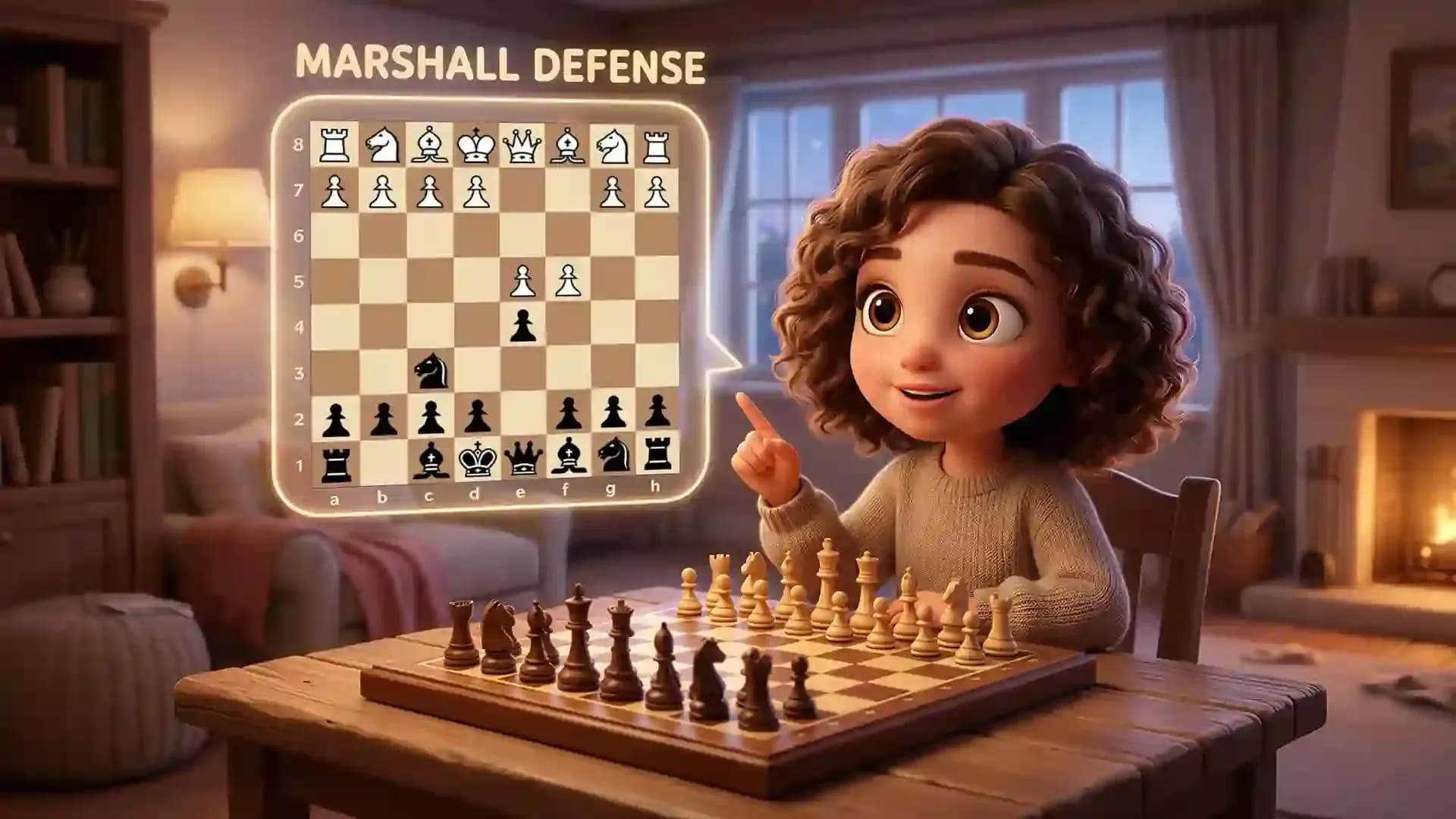
Benko Gambit: The Complete Guide to This Aggressive Chess Opening


Albin Counter Gambit: Sharp Chess Opening Guide
Explore the Albin Counter Gambit in depth with opening theory, positional ideas, critical variations, and practical advice for both White and Black. Learn the plans today.

Dutch Defense: Aggressive Ideas and Winning Plans
Master the Dutch Defense chess opening and learn how to win with 1…f5. Explore attacking plans, structures, and practical strategies now.

Queen’s Indian Defense: Theory, Ideas & Main Lines
Queen’s Indian Defense explained with simple ideas, common variations, and practical tips. Discover how to play this powerful chess opening for Black.

Baltic Defense: Aggressive Chess Opening Explained
Discover the Baltic Defense in chess with clear explanations, key plans, and tactical traps. Improve your opening play and surprise rivals today.

Chigorin Defense: Key Ideas, Theory & Traps
Learn the Chigorin Defense with key ideas, main lines, traps, and strategy tips. Discover how Black creates active play against 1.d4.

One of the most respected and thoroughly analyzed variations for Black against 1.d4 is the Benko Gambit. Instead of using gambits based on the rapid attack on the king’s side or tactical tricks that will make the opponent play incorrectly, this opening offers certain positional benefits.
The Benko gives its practitioner something much more menacing: long-term pressure. By sacrificing a pawn on move 3, Black opens the a and b-file to play chess online with a permanent initiative on the queenside that could last all the way into the endgame.
Table of contents
What Is the Benko Gambit?

The Benko Gambit is an opening played by Black after moves 1.d4 Nf6 2.c4 c5 3.d5 b5. The opening is sometimes called the Volga Gambit in Eastern Europe. The main point of this opening is to put pressure on the white center by offering the sacrifice of the b-pawn.
If White accepts, Black normally plays ...a6, which involves sacrificing another pawn. White and Black trade the b-pawn and also now White's pawn from the c4 square for black's pawn from the a-file. The beauty of this opening (compared to other gambits) is that a gambited pawn does not necessarily mean a quick mate.
The Benko Gambit opening possesses positional compensation." Simply put, Black is not concerned about reaching the endgame since Black will have a greater advantage due to the better quality of pieces and the good structure of the pawns.
A Brief History of the Benko Opening

In regards to the above gambit, it should be noted that there is a history of it that goes back as far as 1933; still, it is only Pal Benko who introduced it to fame through studying its theory. In fact, between 1969 and 1972, while still playing actively, he developed one of the most effective strategies in which the black player was supposed not to win but to have an upper hand. Today, studying these historical lines is often considered the best way to get better at chess for those who value long-term positional pressure.
In 1973, Benko's landmark work 'The Benko Gambit' was published. The Benko Gambit has since been utilized by world champions, namely Garry Kasparov and Viswanathan Anand and even to this day is used by numerous club players and Grandmasters and has so much depth and complexity that White has to be precise for an extremely long period.
Why Play the Benko Gambit? The Core Idea
The main principle of the Benko Gambit player is to apply "permanent headache pressure" on the queenside against the opponent:
The Benko Monster: The dark-squared bishop is played to g7. This becomes the most potent piece in the game, as it travels across the h8-a1 diagonal.
The Semi-Open Files: In the Benko Gambit, it is crucial to remember that Black is the player who sacrifices the b-pawn and a-pawn, not White. By offering these pawns early in the game, Black intentionally gives White extra material in exchange for long-term positional advantages. This is a fundamental concept to get right: White gains the material lead, but Black gains active pieces and open lanes for attack.
The Endgame Paradox: In other gambits, queen exchanges are generally disadvantageous for the attacker but not so with the Benko. Queen exchanges benefit the Black player as White has fewer pieces on the board, reducing his chances of a successful central breakthrough. This makes it a popular choice for those who play chess against computer engines to practice maintaining pressure without the heavy pieces.
Solid Pawn Chain: The pawn structure of Black (normally d6,e6, and g6) is nearly impossible to break down.
Benko Gambit Move Order Explained
The following sequence represents the core of the Benko Gambit. 1.d4 Nf6 2.c4 c5 3.d5 b5
- d4 Nf6: Developing a piece, also preventing e4 by White
- c4 c5: Fighting for the center by attacking White's d4 pawn.
- d5 b5: The key gambit move where Black offers the pawn as bait. This entices White to capture the pawn with 4.cxb5, which opens the a- and b-files for Black.
There are two main responses White may choose. Taking the pawn (The Accepted variation) or Refusing to take the pawn (The Declined variation).
Main Variations of the Benko Gambit
1. The Classical System (King Walk Variation)
This is the most theoretically complex variation of the Benko defense position. This happens when there are moves 4. cxb5 a6 5. bxa6 Bxa6 6. Nc3 g6 7. e4. Here the only thing that both players can do is exchange bishops d7 and f1. By doing so, the king of White loses its rights to castle and go on to g2.
Understanding this struggle between White's extra pawn and Black's activity is a great way to improve at chess, as White is down on space but hopes the material will ultimately prove decisive.
2. The Fianchetto Variation
Instead of offering the b-pawn to c4 to develop his dark-squared bishop to a6, White plays g3 instead. This prepares to fianchetto the white bishop to g2. Black then plays 6...g6 to meet White's setup, and often after this line, it develops the same way as the classical system; however, there are also quite different plans available for Black as well.
In particular, Black can often aim to maneuver his knight to c4 to achieve a good central square, so that it attacks White's d5 pawn as well as the b2 and a2 pawns.
3. The Positional Variation (5.b6)
Many players opt for this move instead of 5.bxa6 and then the Benko Gambit players often play 5...e6, where Black attacks the d5 pawn immediately and the game turns into something more similar to the Benoni structures. With 5.b6, White avoids allowing Black to develop the a and b-file and has played more "safely." This deviation is frequently analyzed by those looking for the best way to study chess, as it requires understanding the subtle transition from gambit pressure to more traditional central tension.
What If White Declines the Benko Gambit?
Sometimes, White might be aware of the Benko Gambit pressure and attempt to deflect the gambit with a variety of move orders. Some of the most common include:
- 4.Nf3: White develops a piece. Black should play the strong move 4...b4, where it gains space on the queenside. There is also the option of 4...Bb7.
- 4.f3: The Zaitsev Variation. This move allows White to build a very strong central pawn chain. Black must fight back fiercely, usually with 4...bxc4 5.e4 d6. This leads to a sharp tactical battle where Black tries to chip away at White's massive center before it becomes too overwhelming.
- 4.a4: This is another common way to decline, where White tries to stop the b-pawn from advancing further. In this case, Black usually continues with 4...b4, creating a closed queenside where the game becomes much more about slow maneuvering and finding outposts for the knights.
Understanding these "Declined" lines is a vital part of a chess improvement plan because it ensures you aren't caught off guard when White refuses to play into your favorite traps.
Is the Benko Gambit Right for You?
The Benko opening (or Volga Gambit) is ideal for players who prefer a long-term initiative to instant checkmate. It is recommended for:
- People who enjoy positional grinding and a strong pawn structure rather than flashy sacrifices.
- Players who enjoy seeing their pawns dominate the board with the dark-squared bishop in action.
- If you want a line that is easy to learn (as long as you remember the core ideas), but very complicated for the opponent to play against correctly for many moves.
- Based on analysis of more than 60,000 games, it has been calculated that against the Benko, White scores about 52%, so you have a winning weapon here at the club level.
Final Thoughts on the Benko Gambit
The Benko Gambit is one of the most genuine and revered replies to the first move of d4. As you lure the opponent into capturing a pawn to achieve a permanent positional strength on the queen’s side, you test all the chess theories through formations that may just be too difficult even for the best. Whether it is blitz or slow games you favor, the Benko will prove very useful as a starting reply. This is unlike the king’s gambit, whose strategy is totally different.
FAQs
- Yes, the Benko Gambit is one of the great chess openings against 1.d4, and it is considered the best black chess opening.
- The goal of playing the Benko Gambit is to sacrifice a pawn in order to open the a and b-files, which will allow you to have an advantage on the queenside with the rook and dark bishop.
- The Benko Gambit was invented by the renowned Hungarian-American grandmaster Pal Benko in 1967. He played this chess opening for the first time, and since then, it has been widely used.
- The main disadvantage of the Benko Gambit is that you are down a pawn, which can lead to a losing endgame if White successfully defends and simplifies the position. Additionally, White can choose to decline the sacrifice, forcing you into a different game where your early pawn moves might become a structural weakness.
Albin Counter Gambit: Sharp Chess Opening Guide
Explore the Albin Counter Gambit in depth with opening theory, positional ideas, critical variations, and practical advice for both White and Black. Learn the plans today.
Dutch Defense: Aggressive Ideas and Winning Plans
Master the Dutch Defense chess opening and learn how to win with 1…f5. Explore attacking plans, structures, and practical strategies now.
Queen’s Indian Defense: Theory, Ideas & Main Lines
Queen’s Indian Defense explained with simple ideas, common variations, and practical tips. Discover how to play this powerful chess opening for Black.
Baltic Defense: Aggressive Chess Opening Explained
Discover the Baltic Defense in chess with clear explanations, key plans, and tactical traps. Improve your opening play and surprise rivals today.
Chigorin Defense: Key Ideas, Theory & Traps
Learn the Chigorin Defense with key ideas, main lines, traps, and strategy tips. Discover how Black creates active play against 1.d4.